

The cooling fluid can be a deciding factor when selecting process plant cooling systems. These systems remove heat from industrial processes to maintain the temperatures needed for equipment operation, process safety and product quality. Unlike comfort cooling, process cooling is designed around machinery, materials and production conditions.
That distinction matters because a system suited to one process may not work for another. Fluid type, supply and return temperatures, flow, contamination risk and heat-rejection conditions all influence the design, along with efficiency and operating costs.
This guide explains how process cooling works and how to assess system options against your process-fluid requirements. It covers cooling performance, energy use, lifecycle costs and the trade-offs between chillers, heat exchangers, cooling towers, dry cooling and evaporative systems, providing a structured basis for comparing solutions.
Key Takeaways
- Start system selection with the process fluid, its temperature range, flow needs, and sensitivity to contamination.
- Understand how heat exchangers transfer heat between process and cooling circuits while keeping fluids separate.
- Compare cooling options against the plant’s sector, operating conditions, water availability, and required process temperatures.
- Assess efficiency across the system lifecycle, including pumping, maintenance, heat recovery, and potential free-cooling opportunities.
- Account for wet-bulb conditions, water treatment, freeze protection, and pump redundancy when planning reliable cooling-tower operation.
What Is Process Cooling?
Process cooling removes heat from industrial equipment, materials or fluids to maintain the conditions production requires. Common system types include once-through, closed-loop, evaporative and air-cooled systems. Compare them by water use, fluid separation, required temperatures and heat-rejection conditions.
Process Cooling Equipment
An industrial chiller cools circulating water or a water-glycol mixture. A heat exchanger instead transfers heat from the process fluid to a separate cooling circuit. This separation can be important when process fluid must not mix with cooling water or its chemical properties could affect equipment. Pumps circulate the cooled fluid between the chiller, exchanger and production equipment.
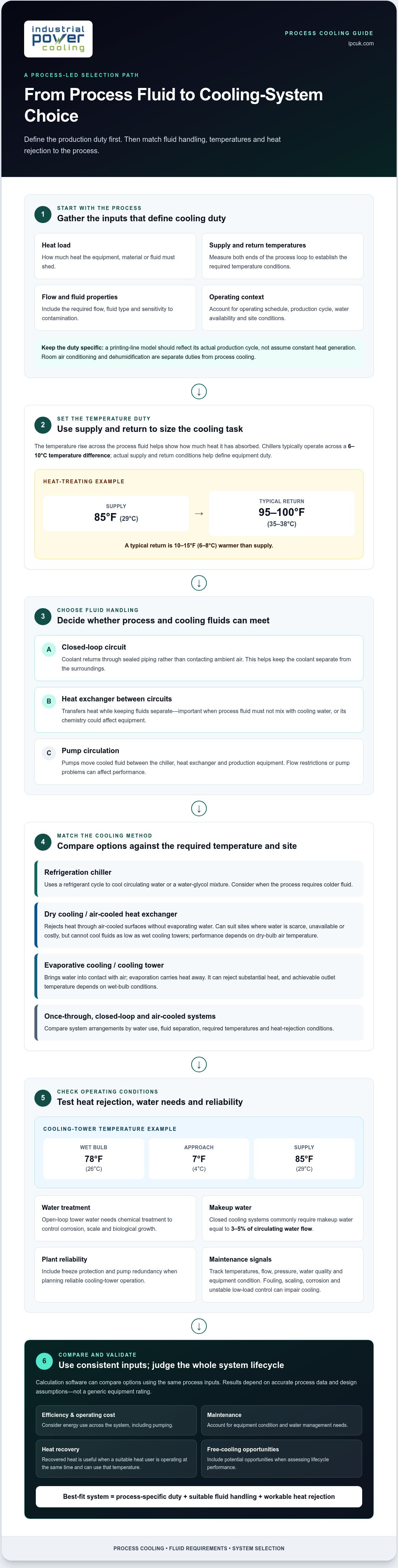
In a closed-loop arrangement, the coolant returns through sealed piping instead of contacting ambient air. Heat exchangers can connect that loop to an open cooling circuit without mixing the fluids. Chillers typically operate across a six-to-10-degree temperature difference, so supply and return conditions help define the equipment duty.
Cooling Methods and Heat Recovery
Refrigeration chillers use a refrigerant cycle to remove heat from process water. Dry cooling rejects heat through air-cooled surfaces without evaporating water, which can suit sites where water is scarce or costly. However, dry systems cannot cool fluids to temperatures as low as wet cooling towers because their performance depends on dry-bulb air temperature.
Waste heat recovery redirects useful heat from a process or refrigeration cycle to another demand instead of rejecting all of it to the atmosphere. Its value depends on whether a suitable heat user is operating at the same time and can use the recovered temperature. This distinction helps separate heat removal from heat reuse.
Cooling for Furnaces and Power Supplies
Heat-treating furnaces and their power supplies need process cooling to remove heat from equipment and support stable operating conditions. The process fluid’s return temperature reflects the heat absorbed, so supply and return measurements help establish the required cooling duty. For heat treating, return fluid is typically 10-15°F (6-8°C) warmer than supply fluid.
For example, a heat-treating process supplied with 85°F (29°C) fluid typically returns fluid at 95-100°F (35-38°C). That temperature rise helps engineers assess the heat exchanger and chiller load. Separate cooling circuits can also keep process fluid apart from equipment-side fluids when their chemistry or cleanliness differs.
Cooling Tower Operation and Heat Transfer
A cooling tower rejects heat by bringing water into contact with air; evaporation carries heat away as the water circulates. Its achievable outlet temperature depends on wet-bulb conditions. At a 78°F (26°C) wet bulb, a tower operating within a 7°F (4°C) approach supplies process fluid at 85°F (29°C).
Open-loop tower water needs chemical treatment to control corrosion, scale, and biological growth. In the United States, industrial cooling-water discharge and cooling-tower requirements are addressed through applicable federal, state, and local rules; permit conditions depend on the discharge route and location. Closed cooling systems commonly require makeup water equal to 3 to 5% of circulating water flow, according to the U.S. Environmental Protection Agency.
Are there tools for “objective” industrial cooling system selection, such as calculation software?
Calculation software can compare cooling options by applying the same process inputs to each design. Start with heat load, supply and return temperatures, flow, operating schedule and fluid properties. For example, a model for a printing line should reflect its actual production cycle rather than assume constant heat generation. Software can organize the comparison, but the results depend on accurate process data and design assumptions.
Industrial process cooling removes heat to maintain equipment conditions and protect materials, product quality and throughput. Requirements differ by sector: plastics moulding may need low cooling-water temperatures, while food processing uses cooling during mixing, fermentation, packaging and storage. Pharmaceutical manufacturing also relies on controlled temperatures during chemical reactions and product storage. These examples show why calculations need process-specific inputs, not a generic equipment rating.
Operating context narrows the options. Air-cooled heat exchangers can suit sites where water is scarce, unavailable, or expensive, but they cannot cool fluids as low as wet cooling towers. Evaporative systems can reject substantial heat through water evaporation, while chillers provide refrigeration when the process requires colder fluid. For civil or commercial users with thermal power up to 1 MW, air or adiabatic systems are generally preferred.
Industrial air conditioning and dehumidification serve a different purpose from process cooling, although a facility may need both. Comfort systems control the occupied environment; process systems control temperatures for production equipment or materials. In pharmaceutical manufacturing, for example, room conditions and vessel cooling are separate duties. Keep these loads distinct in a selection model so room air treatment does not obscure production requirements.
Common problems include fouled heat-transfer surfaces, scaling, corrosion, restricted flow, pump issues and unstable control at low load. Overheating can shorten equipment life, increase maintenance needs and contribute to inconsistent product quality. A maintenance programme should track temperatures, flow, pressure, water quality and equipment condition. Cooling towers also need water management to control scale, corrosion and biological growth.
For an objective comparison, use a consistent input set, then compare cooling capacity, fluid compatibility, water demand, energy use, maintenance needs, and operating conditions. Check how piping routes, control valves, sensors, and minimum-flow requirements affect the complete installation, not just the cooling unit. This approach helps identify where assumptions drive the result and which design trade-offs matter most. For ongoing equipment care, cooling tower and unit maintenance can support reliable operation.
Cooling performance, efficiency, and return on investment
Cooling performance depends on the complete system, not just the chiller. Comparing measured heat transfer, electrical demand and process stability can reveal opportunities to reduce energy use or maintenance needs.
Cooling Performance Metrics
Performance metrics show how effectively a system removes process heat while maintaining the required fluid temperature. Record supply and return temperatures, flow rate, pump power and chiller electricity together. These readings connect thermal duty with energy use, while a stable temperature difference helps protect product quality as production loads change.
Flow matters. Reducing the process temperature difference from 2 degrees to 1 degree doubles the required flow rate, increasing the work expected from pumps and piping. Glycol also changes the fluid’s thermal properties, so the design must account for the actual mixture. Compare readings under similar operating conditions to identify meaningful changes.
Energy Efficiency Measures
Efficiency measures reduce avoidable work across chillers, pumps, heat exchangers and controls. Variable-frequency drives adjust pump speed to changing flow requirements, rather than maintaining constant speed or throttling excess flow. This can match pump output to process demand, particularly when production loads vary during a shift.
Free cooling can reduce chiller operation when ambient conditions permit. It may be possible when process requirements fall within 10-15°F (6-8°C) of ambient conditions. Heat recovery can also redirect usable waste heat to another plant demand. Maintenance supports these measures: dirty coils can force a cooling system to work 27% harder.
Efficiency and Return on Investment
Return on investment relates the initial system investment to ongoing energy use, maintenance and operational effects. Compare options over their working life, not just by equipment capacity. A high-efficiency design may reduce electricity demand, while reliable temperature control can help limit process disruption and protect product quality.
Operating conditions shape the result. Food-processing applications needing fluid at 32°F (0°C) or colder may not have enough free-cooling hours to justify the payback period. An expected free-cooling return on investment of seven to 10 years may also lead a facility to decline that investment.
Build the comparison from measured loads, operating schedules, pump and chiller power, maintenance needs and the value of recovered heat. Include controls and piping, since restrictions or poor flow balance can undermine equipment performance. Then compare projected operating savings with the initial investment, using the same production assumptions for each option. This makes the basis for selecting a system clear.
Cooling towers, wet-bulb conditions, and backup pumps
Cooling tower performance depends on ambient wet-bulb conditions, circulating-water flow, and the heat load. Typical cooling-tower applications serve process-fluid requirements around 70°F to 100°F; pressure and flow rates depend on the system’s piping, equipment resistance, and required heat removal.
Cooling Tower Types
Open-circuit wet towers cool water through direct contact with air, using evaporation to remove heat. Factory-assembled towers arrive as packaged units, while field-erected towers are engineered for large, application-specific heat loads. This affects installation space, integration and capacity planning. Open-circuit systems also need water treatment to manage scale, corrosion and biological growth.
Wet-Bulb Conditions and Cooling Water Parameters
Wet-bulb temperature sets a practical limit for evaporative cooling because tower water approaches, but does not reach, that ambient condition. Evaporative cooling can bring process fluid to a temperature a few degrees above wet-bulb temperature. For example, the New England operating case allowed chillers to shut off when outdoor ambient temperature reached 57°F (14°C), with process water at 67°F (19°C).
Cooling-water pressure and flow rates are calculated from heat load, required temperature rise, pipe length, fittings and equipment resistance. A sound design checks these conditions at peak and reduced loads. Flow below equipment minimums can destabilize operation, while insufficient pressure can prevent the required distribution across tower cells and process users.
Cooling Tower Pumps and Piping
Pumps circulate water between the cooling tower and process equipment, while piping determines flow paths and pressure losses. Pump selection must match the required flow and system resistance, including valves, bends, and heat exchangers. Variable-speed operation can help track changing demand. N+1 redundancy provides a backup unit ready if a pump fails, supporting reliability during continuous operation.
Design also needs freeze protection, bypass piping and minimum-flow provisions, particularly in cold weather or during low-load operation. Expansion tanks absorb changes in water volume as temperatures shift and help maintain system pressure. These details support circulation as the thermal load varies, rather than simply meeting the tower’s rated capacity.
For aging installations, replacement can be phased one cell at a time through online construction, allowing the plant to continue operating during the work. Refineries and chemical plants can pair open-circuit wet towers with shell-and-tube or plate-and-frame heat exchangers. The existing structure, pipe racks, water quality and required heat rejection all shape the replacement design and its integration with industrial cooling equipment.
Choosing a cooling system based on the process fluid
Start with the fluid that needs cooling, because its properties shape heat transfer and equipment selection. Record its composition, operating temperature, flow behaviour and sensitivity to contamination. Clean water may circulate directly through compatible equipment, while a chemical process stream may need to be separated by a heat exchanger. This distinction helps define the cooling circuit before considering equipment capacity.
Fluid chemistry influences the materials in contact with the fluid and the maintenance required. Corrosive or particle-bearing streams can affect pipes, pumps and heat-transfer surfaces, so the design must account for the fluid’s actual condition. For example, process water carrying debris can clog cooling-tower fill and reduce performance. A closed loop with an exchanger can separate that process fluid from the tower circuit, limiting direct contact between the fluids.
Temperature requirements determine how heat can be rejected. Evaporative systems can cool process fluid to a few degrees above air wet-bulb temperature, while air-cooled heat exchangers operate against dry-bulb conditions and cannot reach the same low temperatures as wet towers. If the process requires colder fluid, a mechanical chiller may be needed. The right choice depends on the target temperature and local operating conditions.
Consider water or glycol mixtures when freeze protection or lower operating temperatures affect the circuit. Glycol changes fluid properties, including heat transfer and pumping behaviour, so flow and equipment selection should reflect the actual mixture. For sensitive production materials, stable supply temperature and separation from contaminated streams can matter as much as nominal cooling capacity. Pharmaceutical ingredients and food products are examples where process temperature supports product quality.
Once-through cooling, closed-loop circulation and evaporative tower systems also differ in how they manage process fluid. Once-through arrangements may use water to absorb heat before it leaves the cooling circuit. Closed systems recirculate fluid, while an exchanger can isolate the process side from an open tower circuit. Compare water availability, fluid cleanliness, discharge route and maintenance requirements alongside temperature and flow.
A practical selection record should therefore connect fluid composition to operating temperature, required flow, allowable contamination, and heat-rejection method. Then assess how pumps, piping, valves, and heat exchangers affect the complete circuit. This provides a stronger basis for selecting industrial cooling equipment than starting with a chiller rating alone. Discuss your process-fluid cooling requirements as part of an engineered system assessment.
Industrial Power Cooling (IPC): Dry Coolers
Industrial Power Cooling (IPC) supplies dry coolers for industrial applications where heat must be rejected without evaporating cooling water. Dry cooling can suit facilities with limited water availability, although achievable fluid temperatures depend on ambient dry-bulb conditions and process requirements.
When selecting equipment, match the cooling method to the process fluid, required temperatures, flow conditions and operating environment. IPC also supplies chillers, cooling skids and charge air coolers for different cooling duties. These products can form part of a system designed around the plant’s specific thermal and operational requirements.
For a discussion about cooling equipment suited to your process, contact Industrial Power Cooling (IPC).
Move from system choice to a clear design basis
The next step is to translate production priorities into a design basis for procurement and integration. Record the normal operating profile, expected changes in demand, process-fluid characteristics and the consequences of temperature variation. Then define how the cooling equipment will connect with existing utilities, controls and plant interfaces. This gives engineering teams a consistent reference for evaluating proposals and future modifications.
For process plant cooling systems, the key decision is not simply which unit to purchase, but how the selected equipment will support the facility’s operating objectives over time. Industrial Power Cooling (IPC) supplies dry coolers, chillers and cooling skids for industrial applications. Relate these options to your process requirements, then identify the technical information needed for the next project discussion.
Contact Industrial Power Cooling (IPC) to discuss your application and possible equipment options. A clearly defined design basis is a practical starting point for moving the project forward.
Frequently Asked Questions
What are the commonalities between evaporative and adiabatic cooling?
Both methods use water evaporation to assist heat rejection and can reduce reliance on mechanical refrigeration in suitable conditions. Performance depends on ambient air and the temperature required by the process. In an adiabatic system, air is pre-cooled before reaching the heat exchanger, while evaporative systems may expose circulating water directly to air. Water availability and management help determine which arrangement suits a facility.
What is the difference between cooling in HVAC systems and cooling for industrial applications?
HVAC cooling primarily maintains indoor conditions for occupants, while industrial cooling controls temperatures required by equipment, materials or production processes. A factory may need both: HVAC can condition a control room, while a separate process circuit removes heat from machinery or a production vessel. Industrial design therefore follows process-fluid properties, heat loads, contamination risks and operating schedules, rather than comfort requirements alone.
How to size a process plant cooling system for heat load and flow rate?
Size the system according to the heat entering the process, the required fluid temperature change and the operating profile. For a liquid circuit, heat load equals mass flow multiplied by specific heat capacity and temperature difference. Use peak production conditions, then account for changing loads, piping losses and equipment operating limits. This gives engineers a basis for selecting capacity and circulation equipment.
How much does an industrial process cooling system cost to install and operate?
Installation and operating costs depend on the process duty, selected cooling method, equipment arrangement, site integration, and expected operating hours. Water treatment, pumping, maintenance, and energy demand also affect ongoing expenditure. A meaningful comparison considers the whole system rather than equipment purchase alone. For a project-specific price, the cost depends on the case and is given after a quote request, with scope and design requirements shaping the estimate.
How can process plant cooling systems improve energy and water efficiency?
Process plant cooling systems can improve resource efficiency by matching equipment output to actual demand and limiting unnecessary circulation. Controls can coordinate pumps and cooling equipment as production conditions change, while heat recovery can put rejected thermal energy to use elsewhere. Recirculation and careful management of evaporation and blowdown can improve water efficiency. The best opportunities depend on the facility’s process loads, water constraints and operating pattern.
What water treatment and chemical dosing do process cooling systems require?
Open-loop cooling water requires chemical treatment to control corrosion, scale, and biological growth. Treatment needs depend on water quality and operating conditions; no specific chemicals or dosing rates are given.


