

Cooling performance depends on what happens to process heat after it leaves the equipment. Industrial chillers remove that heat by circulating chilled water or another cooling fluid through a process, then transferring the heat elsewhere. In a vapor-compression system, refrigerant absorbs heat in the evaporator, releases it at the condenser, and cycles back through the system; absorption chillers use a different process.
Stable temperatures are only part of dependable operation. Fouled heat-transfer surfaces, restricted airflow, poor water quality, and corrosion can reduce efficiency and contribute to equipment problems. Maintenance is therefore central to chiller performance.
This article explains how industrial chillers work, where they are used, and how air-cooled and water-cooled designs reject heat. It also outlines how refrigerant choice affects environmental impact and which maintenance checks help protect heat transfer and system condition. Use these principles to inform equipment selection and upkeep.
Key Takeaways
- Understand how a chiller removes process heat and how air-cooled and water-cooled systems reject it differently.
- Compare chiller design against the process temperature, cooling load, available space, water supply, and operating conditions.
- Recognize that low-temperature processes can require specialized equipment, including pumps suited to colder fluid conditions.
- The U.S. Environmental Protection Agency lists the ozone depletion potential of R-290 (propane) as 0; refrigerants also differ in their global-warming potential.
- Prioritize water quality, clean heat-transfer surfaces, clear airflow, and corrosion awareness to support reliable chiller operation.
What Is the Function of an Industrial Chiller?
A chiller removes heat from process equipment and transfers it elsewhere, helping maintain stable operating temperatures. It circulates water or a water-based solution through a process loop, where the fluid absorbs heat before returning to the unit. A pump and reservoir commonly support circulation, while the refrigeration cycle moves heat from the process fluid to the surrounding air or water. Industrial chillers are configured around these process and site requirements.
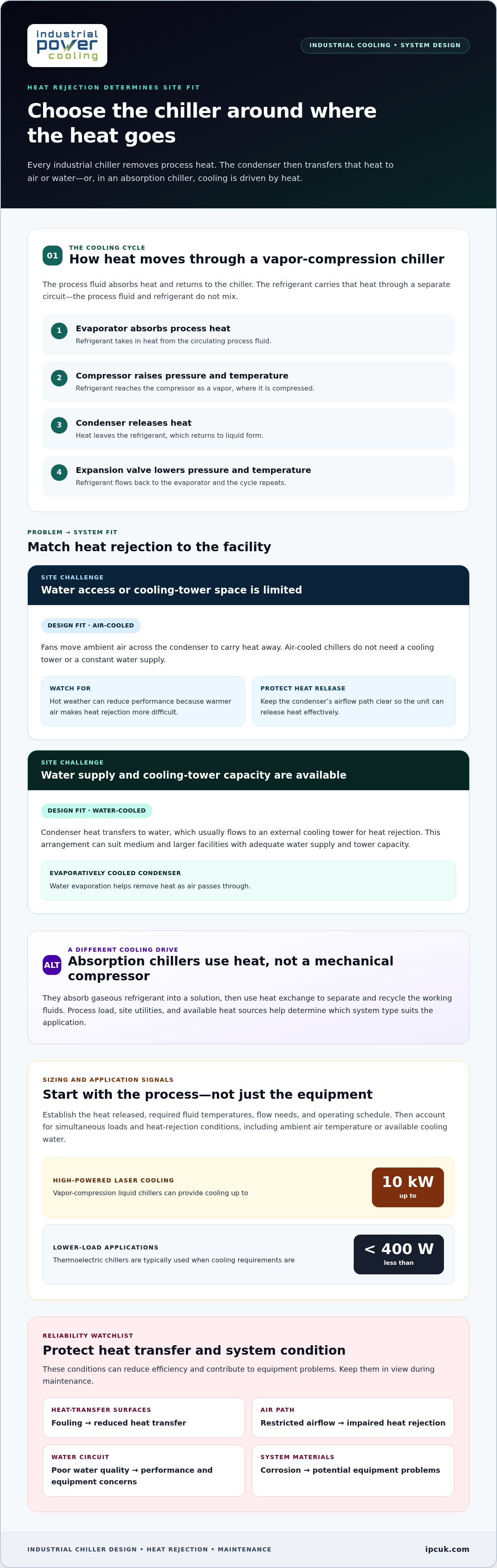
In a vapor-compression system, refrigerant absorbs heat in the evaporator and reaches the compressor as a vapor. The compressor raises its pressure and temperature. The condenser then releases heat, returning the refrigerant to liquid form. An expansion valve reduces its pressure and temperature before it flows back to the evaporator. This repeating cycle cools the process fluid without mixing it with refrigerant.
Air-cooled chillers use fans to move ambient air across the condenser, carrying heat away from the refrigerant. They do not need a cooling tower or a constant water supply, so they can suit sites with limited water access or tower space. Hot weather can reduce performance because warmer air makes heat rejection more difficult. Keep the condenser’s airflow path clear to help the unit release heat effectively.
Water-cooled chillers transfer condenser heat to water, which usually flows to an external cooling tower for heat rejection. This arrangement can suit medium and larger facilities with adequate water supply and tower capacity. In an evaporatively cooled condenser, water evaporation helps remove heat as air passes through. The options differ in equipment, water requirements, and response to ambient conditions.
Absorption chillers use heat, rather than a mechanical compressor, to drive cooling. They absorb gaseous refrigerant into a solution, then use heat exchange to separate and recycle the working fluids. Vapor-compression chillers instead reject condenser heat through air or water. For industrial chillers, process load, site utilities, and available heat sources help determine which system type suits the application.
Choose buying, leasing, or renting according to the expected duty period, capital priorities, and need for long-term control. Compare these factors with the equipment’s operating and maintenance requirements. The right arrangement depends on how consistently the process needs cooling and how the equipment fits the facility’s plans.
Installation and commissioning generally involve preparing the site and utilities, positioning the equipment, making process-pipe and electrical connections, checking the system, charging fluids, and starting up in a controlled way. Technicians then verify circulation, temperatures, controls, and condenser heat rejection under operating conditions before handing over the system.
Industrial-grade chiller construction and applications
Industrial chiller design brings together the cooling load, fluid circuit, evaporator, controls, and heat-rejection equipment. Their configuration determines how well the system supports equipment under changing operating conditions.
Chiller Applications Across Facilities
A chiller may serve a building’s air-handling equipment or remove heat directly from industrial machinery. The distinction matters: process cooling must match the equipment’s operating needs, while building systems distribute chilled liquid through piping to air-handling units.
Commercial facilities such as airports, hospitals, hotels, and shopping malls commonly use water-cooled chillers where water supplies and cooling towers are available. In industrial settings, a process loop can serve assembly equipment or lasers. Medical applications include MRI machines, where controlled cooling supports equipment operation.
Laser systems illustrate why capacity and application must be considered together: vapor-compression liquid chillers for high-powered lasers can provide cooling up to 10 kW. Thermoelectric chillers are typically used when cooling requirements are less than 400 watts, making them suited to lower-load applications rather than larger process demands.
Industrial Chiller Construction and Sizing
Industrial-grade systems commonly include a pump and liquid reservoir to circulate fluid between the chiller and connected equipment. The evaporator transfers process heat into the refrigerant circuit, while controls coordinate operation. Component selection should account for the process fluid, connection layout, equipment duty, and conditions around the chiller.
To size a chiller for a facility or process, establish the heat released by the equipment, required fluid temperatures, flow needs, and operating schedule. Then account for simultaneous loads and conditions that affect heat rejection, such as ambient air temperature or available cooling water.
These inputs also shape efficiency. A unit selected for peak load may operate differently from one serving a steady process. For example, an assembly line with several cooling points requires consideration of the combined load and distribution needs, alongside each machine’s individual demand.
For facilities integrating several process loads, bespoke industrial cooling systems can bring the chiller, pipework, and controls into one coordinated design. Matching the equipment to the application helps align cooling delivery with the facility’s actual process requirements.
Low-temperature process chilling
Low-temperature process chilling removes heat from fluids or equipment that must operate below ordinary chilled-water conditions. Industrial liquid chillers can produce temperatures as low as -40°F (-40°C), supporting below-freezing applications. The required temperature alone doesn’t define the system: process load, fluid properties, flow rate, and pressure drop also affect component selection and operating stability.
In a process-water circuit, a pump moves cooled fluid from the chiller to the equipment, where it absorbs heat. The returning fluid passes through the chiller’s heat exchanger, and the cycle repeats. A reservoir can support circulation, while pipework and controls direct flow to each cooling point. For example, a production line with several temperature-sensitive machines needs distribution designed around their combined demand.
Fluid choice becomes important as temperatures fall. Water-based solutions may include glycerol to transfer heat in applications requiring freeze protection. Below −5 °C, a process chiller may require a special pump; colder fluid conditions affect viscosity and the pump’s operating requirements. Correct circulation helps maintain heat transfer and prevents a mismatch between the chiller’s capacity and the process loop.
Low-temperature systems also need to manage pressure across the circuit. Pipe length, bends, valves, and equipment passages affect resistance to flow, while temperature affects fluid behavior. The pump must circulate the selected fluid through the whole loop, not merely meet the chiller connection requirements. These factors also matter outdoors, where surrounding conditions can affect exposed pipework and heat rejection.
Cooling-tower arrangements are another design consideration. A tower may serve a water-cooled chiller’s condenser, but it does not determine process-fluid temperature by itself. The chiller’s refrigeration components provide the required cooling, while the tower helps reject condenser heat. Designers consider process temperature and heat rejection as connected but distinct parts of the system.
Compare TCA and TCX process chiller ranges using the same engineering criteria: required outlet temperature, process load, fluid type, flow, pressure drop, and operating environment. Range names alone do not show whether a unit suits a particular duty. A useful comparison connects each application’s temperature profile and cooling demand with equipment capacity, pump performance, and the full circulation circuit.
For a below-freezing process, establish the required fluid temperature first, then determine the heat load and flow conditions. Next, account for fluid properties, pressure losses, pump selection, pipework exposure, and condenser heat rejection. This sequence helps identify the system components that must work together to maintain the specified process conditions.
Refrigerant ozone-depletion and global-warming potentials
Refrigerant choice affects heat transfer, system design, and environmental impact. Ozone depletion potential and global-warming potential describe different environmental characteristics.
Refrigerant Environmental Impacts
Ozone depletion potential (ODP) indicates a refrigerant’s potential to harm the ozone layer, while global-warming potential (GWP) compares its heat-trapping effect. According to the U.S. Environmental Protection Agency, R-290 (propane) has an ODP of 0 and a GWP of 3. For comparison, listed GWPs are 1 for R744 (carbon dioxide), 0 for R-717 (ammonia), and 1430 for R-134a.
These measures help distinguish environmental effects, but they do not determine whether a refrigerant suits a particular process-cooling duty. Required temperature, system design, and refrigerant properties all influence selection. A refrigerant’s environmental profile also matters throughout the equipment’s operating life, since leaks can release refrigerant into the atmosphere. The appropriate choice balances thermal performance with environmental considerations.
U.S. Refrigerant Requirements
U.S. refrigerant requirements govern refrigerant use and equipment operation, and matter during chiller specification, installation, and servicing. No single requirement applies identically to every system. Rules depend on the refrigerant, equipment, and applicable federal, state, and local requirements, so project teams need to identify the rules for the system and location.
The refrigeration cycle shows why refrigerant properties affect chiller operation. In the evaporator, refrigerant absorbs heat from process fluid and changes state. The compressor raises its pressure and temperature, allowing the condenser to transfer heat to ambient air or cooling water. After condensation, an expansion valve reduces pressure and temperature before the refrigerant returns to the evaporator.
Each stage depends on controlled heat transfer. The evaporator must absorb heat from the process fluid, while the condenser releases that heat to its surroundings. Refrigerant choice affects the temperatures and pressures at which these components operate. Process load and required cooling temperature therefore inform both equipment design and refrigerant selection.
When comparing options, use ODP and GWP alongside the process temperature and equipment requirements. R-290’s listed ODP of 0 and GWP of 3 describe environmental measures, not system capacity or suitability. Values for R744, R-717, and R-134a likewise provide comparison points, while the chiller’s application determines the operating conditions it must meet.
For a U.S. project, identify the proposed refrigerant and applicable requirements before installation and servicing. This connects environmental considerations with the equipment’s design and operating needs.
Industrial chiller maintenance
Routine maintenance protects heat transfer, cooling capacity, and process stability. Review the water circuit, condenser, compressor, and controls as connected parts of the system. Restricted water flow, for example, can impair heat transfer even while the compressor continues running. Maintenance should examine individual components and the conditions affecting the complete cooling loop. These checks help keep industrial chillers aligned with process demands.
Water treatment needs close attention in water-cooled systems. Inadequate treatment can introduce sediment, minerals, and bacteria, contributing to corrosion in metal pipes. Sediment and particulates can also clog chiller pipes and reduce heat transfer. Open cooling towers need particular care because dirty tower water can carry debris into the connected circuit. Treatment and cleanliness help limit these sources of fouling.
Air-cooled condensers need an unobstructed airflow path. Dirt or debris blocking the condenser can reduce chiller efficiency by interfering with heat rejection. Inspect the condenser surface and surrounding airflow path, and address visible obstructions during planned upkeep. In water-cooled systems, inspect the condenser water circuit and cooling tower for contamination that could affect heat exchange.
Corrosion can develop where pipework combines metals with different electrochemical properties. Check joints, pipe surfaces, and connection areas for corrosion or leaks. A leak can damage the chiller, reduce efficiency, and affect nearby equipment or surfaces. Finding corrosion early helps identify where the water circuit or material combination needs attention before further damage occurs.
Mechanical and control checks should cover the compressor, expansion valve, pumps, and electrical connections. The compressor raises refrigerant pressure and temperature; the expansion valve lowers them before refrigerant returns to the evaporator. A change in operating behavior can involve more than one component. Compare process temperatures, pressure readings, and liquid circulation with established operating records, and investigate changes rather than treating them as isolated symptoms.
For absorption chillers, include the solution circuit and heat-exchange process in maintenance reviews. For vapor-compression equipment, monitor the refrigeration cycle and condenser performance. In either design, energy use and cooling output provide useful context when reviewing operating records. Maintenance plans for industrial chillers should reflect system type, water quality, site conditions, and process demands, rather than applying one schedule to every installation.
Industrial Power Cooling (IPC) provides cooling tower and unit maintenance and repairs. If fouling, corrosion, or reduced heat transfer is affecting a cooling system, arrange cooling tower and chiller maintenance to address the equipment and its operating conditions.
Industrial Power Cooling (IPC): Dry Coolers
Industrial Power Cooling (IPC) helps industrial operators assess cooling equipment against process requirements, including whether a dry cooler may suit the heat-rejection duty. Dry coolers transfer heat from circulating fluid to ambient air, while chillers provide active refrigeration when process temperatures require it. Cooling skids can integrate equipment for process applications, and charge air coolers address heat from compressed intake air.
When reviewing an existing system or planning a new installation, consider the required process temperature, heat load, fluid circuit, and site conditions. These factors help clarify whether a dry cooler, chiller, or another configuration suits the application. Contact Industrial Power Cooling (IPC) to discuss your industrial cooling requirements.
Set a Clear Direction for Your Cooling Project
Turn operating requirements into a practical project brief before finalizing equipment decisions. Record the process duty, site constraints, connections to existing systems, and maintenance priorities. This gives engineering discussions a clear starting point and keeps equipment selection tied to the cooling system’s intended role. For industrial chillers, define how the unit fits into the wider process rather than treating it as an isolated purchase.
Industrial Power Cooling (IPC) supplies dry coolers, chillers, and cooling skids for industrial cooling requirements. These options serve different system roles, so discussions can focus on the application and its interfaces rather than a generic equipment choice.
Prepare the key process and site requirements, then contact Industrial Power Cooling (IPC) to discuss a suitable direction for your project. A clear brief is a constructive first step toward a well-considered cooling system.
Frequently Asked Questions
Frequently Asked Questions: How Does a Chiller Work?
A chiller removes heat from a process or space and rejects it elsewhere. In a vapor-compression model, refrigerant absorbs heat at the evaporator, then carries it through a compressor and condenser before cycling back. For operators, the chiller display shows only part of system performance. Compare readings with process temperatures and flow conditions to spot changes that may affect production.
Chapter One: What Is a Chiller?
A chiller cools a circulating liquid so it can collect heat from a process or building. Unlike a fan or ventilation unit, it sends cooling fluid through a dedicated loop to the equipment requiring heat removal. For example, a machine can transfer heat into a liquid circuit while remaining separate from the chiller, allowing cooling to serve a defined process area.
What Are the Main Components of a Chiller?
A vapor-compression chiller typically includes an evaporator, compressor, condenser, and expansion device, supported by pumps, controls, and fluid connections. Each has a distinct role: the evaporator receives process heat, the compressor drives refrigerant through the cycle, the condenser rejects heat, and the expansion device prepares refrigerant for another pass. A pump failure, for instance, can interrupt process-fluid circulation even if the refrigeration circuit remains operational.
What Is the Purpose of a Chiller?
A chiller controls unwanted heat so equipment or a process can stay within required operating conditions. This supports product consistency and helps keep heat-sensitive machinery within its intended range. In a production facility, a chiller can serve a process loop independently of general building comfort cooling. Defining equipment temperature limits and operating patterns helps establish what the cooling system must accomplish.
Where Are Chillers Used?
Chillers serve buildings, commercial facilities, industrial processes, and medical equipment. Examples include cooling circuits for production machinery, building air-handling systems, and equipment such as MRI machines. Data centres also use cooling systems to manage heat from computing equipment. A system’s role varies by site: a building may distribute cooled liquid among air handlers, while a process plant directs it to specific production equipment.
What Is an Industrial Chiller and How Does It Work?
Industrial chillers are cooling units configured to remove heat from process equipment or machinery. A pump moves liquid through a circuit, where it absorbs process heat before the system transfers that heat elsewhere. Assess the process load, fluid requirements, and operating conditions together. This distinguishes process-specific cooling from systems intended mainly for occupied spaces and guides decisions about how the equipment fits the wider facility.
What Types of Chillers Are Available, and How Do They Compare?
Common types of industrial chillers include air-cooled, water-cooled, and absorption chillers. Air-cooled units reject heat to ambient air; water-cooled designs transfer condenser heat to water, often linked to a cooling tower. Absorption systems use heat to drive cooling rather than a mechanical compressor. Compare site utilities, available space, process conditions, and maintenance needs to assess which arrangement best fits the application.
How Much Electricity Do Industrial Chillers Use, and What Are Their Operating Costs?
Electricity use by industrial chillers depends on cooling demand, operating hours, system efficiency, and conditions affecting heat rejection. Estimate consumption by relating the unit’s electrical demand to its runtime, then compare the result with the facility’s electricity tariff. Operating expenses also reflect water use, maintenance, and process conditions. Equipment and system requirements shape project costs, which depend on the particular application.


