

A dry cooler can keep running even as fouled heat-transfer surfaces or developing fan problems affect its performance. A structured approach to dry cooler maintenance helps plant engineers spot changes early and plan inspections around operating demands, rather than relying on a fixed routine that may not suit the equipment or site.
When maintenance windows are limited, clear inspection tasks and intervals make planning easier. Base the schedule on the equipment manufacturer’s documentation and site conditions, and plan all work in line with site safety procedures and the equipment manual.
This guide covers how to inspect airflow, heat-transfer surfaces, fans and other components, how to clean where appropriate, and which signs may need further diagnosis or repair. It also explains what to record so inspection findings can inform future planning and technical support. Whether work is routine or one-off, tailor its scope to the cooler and its operating context.
Key Takeaways
- Set inspection priorities according to site exposure, operating duty and equipment condition, rather than assuming one schedule suits every unit.
- Use a documented workflow: review equipment guidance, inspect airflow and heat-transfer surfaces, clean where appropriate, then record findings.
- Include fans, motors, controls, coil surfaces and visible pipework connections in a consistent dry cooler maintenance routine.
- Treat unusual noise, vibration or temperature changes as reasons to investigate, not as a diagnosis.
- Use maintenance records to spot recurring issues and decide when specialist support or a wider cooling-unit assessment is appropriate.
Why dry cooler maintenance starts with site conditions and performance
Dry cooler maintenance includes planned inspection, cleaning and condition checks, considered alongside the conditions in which the unit operates. A routine that suits a relatively clean, open installation may not suit equipment exposed to airborne dust, leaf litter or process debris. Prioritise checks according to what could reach the heat-transfer surfaces, restrict airflow or make access difficult.
Site conditions can change. Seasonal shifts, nearby work, changes in production duty or alterations to the surrounding area may affect the cooler’s workload and maintenance needs. Record these changes alongside observations of temperature, airflow and operating behaviour. Comparing current readings and conditions with the equipment’s normal baseline can help reveal a change, although a symptom alone does not establish its cause.
A suitable maintenance plan reflects both the equipment’s condition and the conditions in which it must perform. Use manufacturer guidance, site exposure and observed condition to set priorities and inspection timing, rather than applying an unsupported universal interval.
Which operating conditions change dry cooler maintenance priorities?
In a dusty location, accumulated particles may make coil surfaces and airflow paths a higher inspection priority. Where leaves, fibres or other debris are common, note where they collect and whether they obstruct air movement. A cleaner location may call for a different emphasis, but visual checks still help identify unexpected changes.
Restricted access can make it harder to view surfaces or check airflow consistently. Nearby walls, stored materials or other obstructions may also affect the air path, so include the space around the unit in the assessment. Document seasonal conditions, process changes and site work that could alter debris exposure, access or operating duty. These details help explain changes in workload and support practical maintenance planning.
Which equipment documents should guide the routine?
Start with the equipment manual, manufacturer instructions and site maintenance procedures. Use these to identify relevant inspection guidance and site requirements. Confirm the cooler model and its components before planning work, then locate any specified cleaning methods and restrictions. Similar-looking units may have different parts or servicing needs.
Keep general visual checks separate from intrusive tasks. Record visible debris, apparent damage or an obstructed area during an inspection. Work involving electrical components, access inside equipment or other specialist tasks must follow applicable site procedures and equipment documentation. If the instructions do not support a planned method, don’t improvise. Use the documentation to define what can be checked routinely and where trained personnel or manufacturer guidance are needed.
How to inspect and clean dry cooler airflow and heat-transfer surfaces
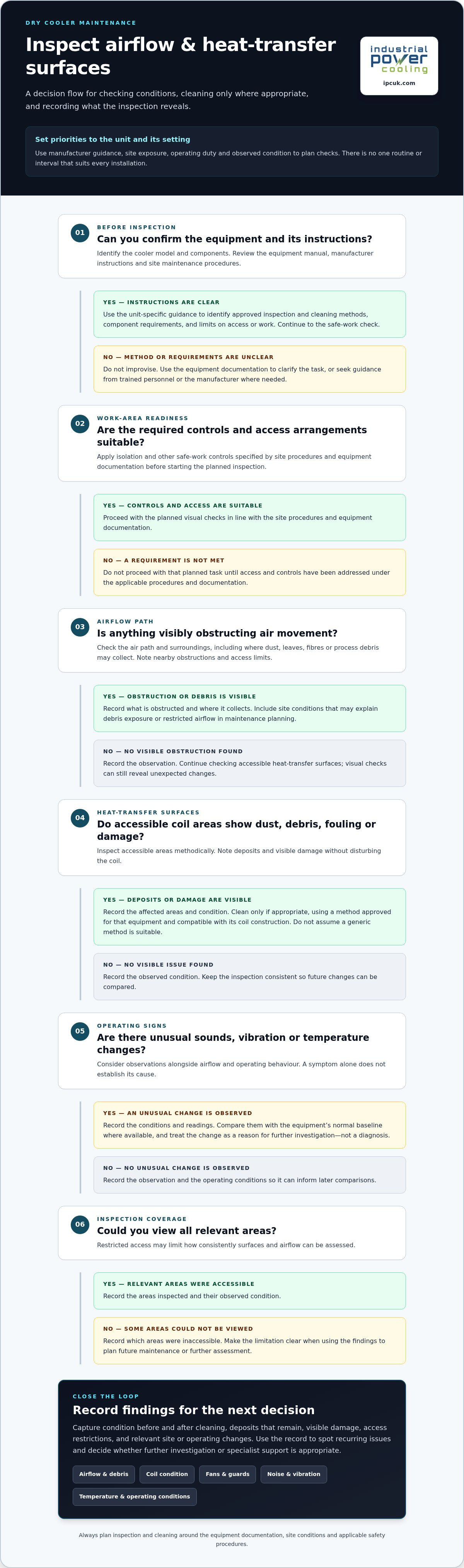
A consistent workflow helps technicians assess airflow and heat-transfer surfaces without assuming every cooler is the same. Before starting, identify the equipment model, review its instructions and establish the site’s safe-work requirements. Follow the guidance for the unit and its coil construction, rather than using a generic cleaning method that could damage components.
Unobstructed airflow and clean heat-transfer surfaces allow a dry cooler to reject heat as intended. Inspect the air path and surface condition together.
- Review documentation. Check the equipment manual, manufacturer instructions and site procedures. Identify approved inspection and cleaning methods, relevant components, and any limits on access or work.
- Prepare the work area. Apply isolation and other safe-work controls specified by applicable site procedures and equipment documentation. Confirm the work area and access arrangements are suitable for the planned inspection.
- Inspect airflow paths and accessible components. Look for visible obstructions, damage, unusual noise or vibration. Check guards and accessible fan components only in accordance with site procedures. Don’t reach into or work on energised equipment.
- Inspect the heat-transfer surfaces. Look across accessible coil areas for dust, debris, visible fouling or damage. Note any areas that cannot be viewed, since limited access may restrict the assessment.
- Clean if appropriate, then record findings. Use only a method approved for the coil and compatible with its construction. Record its condition before and after cleaning, any deposits that remain, and any damage or access restrictions.
How should technicians inspect fans, guards and airflow paths?
With the required safe-work controls in place, check for material blocking the air path and note apparent damage to guards or accessible fan components. If unusual noise or vibration is observed during operation, record the conditions and follow site procedures for further investigation. Don’t treat sound or vibration as a diagnosis. The Air-Cooled Heat Exchanger Maintenance Guidelines from Dry Coolers, Inc. provide relevant guidance to consider alongside the unit’s own documentation.
How should coil surfaces be checked and cleaned?
Inspect accessible surfaces methodically. Note where dust or debris has accumulated and whether deposits appear persistent. Check for visible damage without disturbing the coil. Before cleaning, verify the approved method for the specific equipment and surface. Don’t assume a tool, water application or cleaning product suitable for another unit is appropriate here. Record the method used and any residue or damage that needs further assessment.
Clear records make the next inspection more useful by showing what has changed and what remains unresolved. If cleaning access is limited or findings point to a wider equipment concern, IPC provides cooling unit maintenance and repair support for routine or one-off requirements.
How to assess dry cooler components and recognise developing faults
Inspection findings are most useful when they link a component, an observable change and a sensible next action. The aim of dry cooler maintenance is to recognise departures from normal operation and gather context for follow-up, not to diagnose a fault from one symptom. Compare observations with equipment records where operating conditions are similar, and follow site procedures for further checks.
Organise routine observations around fans and motors, coil surfaces, electrical controls and visible pipework connections. Note conditions and changes without opening panels or carrying out tests beyond the person’s competence and authorised scope. A temperature change, for example, may relate to several operating or equipment factors. It is a reason to investigate in context, not proof of a particular failure.
What do changes in noise, vibration or temperature indicate?
A new sound, increased vibration or temperature shift can signal a change, but none identifies a cause on its own. Compare readings or observations with the established baseline only when operating conditions make the comparison meaningful. Record when the change occurred, the unit’s operating context, the affected component and any related performance observations. This gives follow-up personnel useful evidence without turning an initial observation into a diagnosis.
| Observation | Possible significance | Next action |
|---|---|---|
| Unusual fan noise | A change in fan operation or a nearby obstruction may be involved. | Record when it occurs and arrange further investigation under site procedures. |
| New or increased vibration | A mechanical change may be present, but vibration alone does not establish the source. | Note the affected area and operating conditions, then escalate for competent assessment. |
| Temperature change | Operating duty, airflow or equipment condition may be relevant. | Compare with meaningful baseline records and investigate persistent changes. |
| Visible coil fouling or damage | Surface condition may affect heat transfer or need repair assessment. | Document the location and extent, then follow equipment guidance. |
Which electrical and mechanical checks need controlled procedures?
Control panels, fan motors and accessible mechanical components are useful inspection areas, but visual observation is not the same as intrusive work. Before electrical or mechanical checks, apply site-approved isolation and safe-work controls, and assign the task to competent personnel. Testing, adjustment or repair must follow equipment-specific procedures and documentation.
Don’t infer electrical condition from external appearance or apply generic test values, torque settings or replacement criteria. If an observation recurs, performance continues to change, or the required investigation exceeds site competence, retain the findings and escalate through the appropriate maintenance process. Clear records help technical support assess the whole cooling unit in its operating context.
How to build a dry cooler maintenance schedule and useful service records
A practical schedule turns equipment guidance and site experience into planned work. Make it specific to the cooler, its exposure and operating duty, and review it when the unit’s condition or surroundings change. Don’t impose standard daily, monthly or annual intervals without support from the equipment documentation and site assessment.
Build the schedule in a controlled sequence:
- Start with manufacturer guidance. Identify recommended inspection and service tasks for the specific model, including any conditions that affect timing.
- Account for site exposure. Consider dust, debris, access restrictions and other environmental factors that influence maintenance priorities.
- Consider operating duty. Record how the unit is used and note seasonal or process changes that may affect its workload.
- Use observed condition. Review inspection findings, recurring fouling and performance changes alongside the manufacturer’s recommendations.
- Approve and document the plan. Set model- and site-specific timing through the site maintenance process, and record the rationale for the schedule.
How should inspection frequency be set?
Use the manufacturer’s recommendations as a baseline, then assess whether site exposure, operating duty or inspection findings call for a review. Repeated fouling or changed site conditions may indicate that the plan needs reassessment, but they don’t establish a universal interval. Submit proposed changes through the site maintenance approval process, retaining the reason and supporting observations.
What should a dry cooler maintenance log capture?
A useful log makes each entry identifiable and comparable. Record the equipment identification, inspection date, operating state and person completing the work. Include observations, work performed, materials or parts used, and any unresolved issue or follow-up action. Use consistent descriptions so a later reviewer can distinguish a new condition from one already recorded.
A simple entry might read: Equipment ID: [unit]; date: [date]; operating state: [state]; observation: [location and condition]; work: [task completed and materials used]; follow-up: [action owner or status]. This is a format example, not a prescribed maintenance interval or technical specification.
- Describe location and extent. “Debris at the lower coil section” is more useful than “dirty.”
- Separate findings from actions. Note what was observed, what work was completed and what remains unresolved.
- Retain operating context. Include relevant duty or site changes so future comparisons are meaningful.
Consistent entries can reveal whether the same areas foul repeatedly, whether a performance change recurs under similar conditions, or whether follow-up work remains open. Review these patterns when planning future tasks and share the records when seeking technical troubleshooting. Arrange dry cooler maintenance support with IPC for routine or one-off requirements tailored to the equipment and site.
When dry cooler maintenance needs specialist support from IPC
Routine inspection helps plant teams identify changes, but some findings call for a wider technical review. Persistent performance changes, visible damage, recurring faults, uncertain causes or work beyond site competence are reasons to escalate through the site’s maintenance process. Consider whether repeated symptoms relate to the unit, its operating conditions or the wider cooling system, rather than treating each occurrence in isolation.
Before arranging a review, gather the equipment identification, maintenance history, relevant operating observations and a clear description of the issue. Records showing when a change began, whether it recurs and what work has already been completed help frame the discussion. They support a structured assessment but do not establish a diagnosis or guarantee a particular repair outcome.
When should a dry cooler issue move beyond routine inspection?
Escalate when a performance concern persists, visible damage is found, a fault returns after previous work, or the cause remains uncertain. Seek support when the next check or repair exceeds the competence or authorised scope of site personnel. Preserve inspection records and operating context so the technical review can consider both the symptom and the conditions in which it occurs.
Useful information to assemble includes:
- Equipment identification and relevant manufacturer documentation.
- Dates and operating conditions associated with the change.
- Inspection findings, maintenance completed and any unresolved observations.
- How the issue affects the cooling unit’s operation or process requirements.
This context helps distinguish a one-off observation from a recurring pattern and provides a sound basis for deciding what further assessment is appropriate. Avoid changing settings or carrying out intrusive work outside site procedures while the cause is being investigated.
How can IPC support industrial cooling maintenance?
Industrial Power Cooling provides routine and one-off maintenance and repair services for cooling towers and cooling units, tailored to the equipment and site requirements. Findings can also inform a broader assessment of the cooling unit and its operating context, particularly where repeated issues suggest that factors beyond a single component warrant consideration.
IPC designs, manufactures and installs bespoke industrial cooling systems, bringing wider project context to maintenance discussions. A review can begin with the equipment, the observed issue and the available service records, then establish a suitable scope for the requirement.
For persistent changes, recurring faults or work outside your team’s remit, discuss your cooling-unit maintenance requirements with IPC. Sharing relevant observations and site context helps focus the conversation on routine or one-off maintenance and repair needs.
Make your maintenance plan support the next operating cycle
A useful maintenance plan does more than record completed tasks. Use each inspection to improve the next work plan: preserve relevant findings, identify unresolved concerns and apply site experience to future decisions. This gives plant teams a clearer basis for coordinating dry cooler maintenance with operational requirements and escalating issues that need a broader technical assessment.
Industrial Power Cooling has supported industrial cooling requirements for over 20 years. Its maintenance and repair services for clients across the globe sit alongside bespoke design, manufacture and installation capabilities. This wider engineering perspective can help place a unit’s condition in the context of its cooling system and site.
For routine or one-off requirements, discuss the equipment, operating context and maintenance findings with IPC. Discuss your industrial cooling maintenance requirements and identify a practical next step for your site.
A clear plan and appropriate technical support help your team prepare for future maintenance work.
Frequently Asked Questions
How often should a dry cooler be serviced?
There is no universal service interval for every unit. Set timing using the manufacturer’s guidance, then account for operating duty, site environment and observed condition. For example, a change in nearby processes that increases airborne debris may justify reviewing inspection priorities. Record why the schedule was set and reassess it when conditions or equipment performance change. Use the site’s maintenance approval process before altering established intervals.
How do you clean a dry cooler coil?
Inspect the coil first, then use only a cleaning method approved for the equipment and its coil construction. Check the manufacturer’s instructions for the correct approach, and follow applicable site safety and isolation procedures before work. A method suitable for one coil may be inappropriate for another, so avoid improvised tools or cleaning products. Afterward, record the areas treated and any deposits or damage that remain.
What should be checked during dry cooler maintenance?
Check airflow paths for obstructions, fans and guards for visible damage, coils for fouling, and the unit for unusual operating behaviour. Include control-panel condition and visible pipework issues. Compare findings with the unit’s documented normal condition where possible, and note the location of anything unusual. These observations help identify changes from existing conditions. Leave panel access, electrical testing and other intrusive work to competent personnel following equipment-specific instructions and site procedures.
Can a dry cooler operate with a dirty coil?
A dry cooler may continue operating with a dirty coil, but deposits can obstruct airflow or interfere with heat transfer. The effect depends on the unit, the extent and location of fouling, and operating conditions, so appearance alone does not establish the impact on performance. Inspect the surface and consider relevant operating observations. If cleaning is appropriate, use the method specified for the equipment, then monitor whether the concern persists.
What causes a dry cooler to make unusual noise or vibrate?
Several mechanical or operating conditions may contribute to unusual noise or vibration, and the symptom alone does not identify the cause. Note when it occurs, which area appears affected, and whether operating conditions differ from the normal baseline. Don’t reach into equipment or attempt adjustments outside your authorised scope. Record the observation and follow site procedures for further assessment, particularly if the symptom persists or recurs.
Do dry coolers need maintenance in winter?
Winter maintenance needs depend on equipment design, whether the unit is operating or idle, site conditions and manufacturer guidance. Seasonal checks may need to account for changes in operating status or the transition between operating periods, but the correct tasks are model-specific. Consult the applicable operating and maintenance instructions before planning work, and follow site procedures for safe access and isolation. Record any seasonal condition that affects future planning.
When should a dry cooler be repaired rather than routinely maintained?
Routine maintenance covers planned checks and care. Repair assessment is appropriate when performance changes persist, visible damage appears or a fault keeps returning. Unresolved symptoms or work beyond site personnel’s competence also warrant escalation. Before arranging a technical review, gather the equipment identification, relevant operating observations and maintenance history. This helps specialists assess the issue in context without assuming a cause or repair outcome in advance.


