

The simplest answer to dry cooler versus cooling tower may be the wrong one. Avoiding evaporative water use is not enough if the process cannot meet its temperature target in hot ambient conditions. A dry cooler’s performance depends closely on air temperature, while a cooling tower uses evaporation to reject heat and brings water management and maintenance requirements.
Equipment selection is about more than comparing labels. The right choice depends on the process duty, required temperatures, site climate, water availability and the operating demands the facility can support. Weigh temperature performance and water use together rather than treating either as a secondary concern.
This article explains how each approach rejects heat and how ambient conditions affect performance. It also covers the site and process factors that should guide selection, including when a hybrid arrangement may be worth assessing. Industrial Power Cooling designs, manufactures and installs bespoke systems, matching equipment to the process duty and installation requirements.
Key Takeaways
- Compare how each system transfers heat between process fluid, air and water.
- Assess required process-fluid supply temperatures across design conditions and seasonal operation, not just at one design point.
- Weigh temperature potential, water requirements, site conditions and maintenance needs when comparing a dry cooler with a cooling tower.
- Screen options in sequence, separating essential process requirements from preferences such as reducing water dependence.
- Consider bespoke or hybrid engineering when equipment, controls and site pipework need to work together around a specific duty.
Dry Cooler Versus Cooling Tower: What Is the Fundamental Difference?
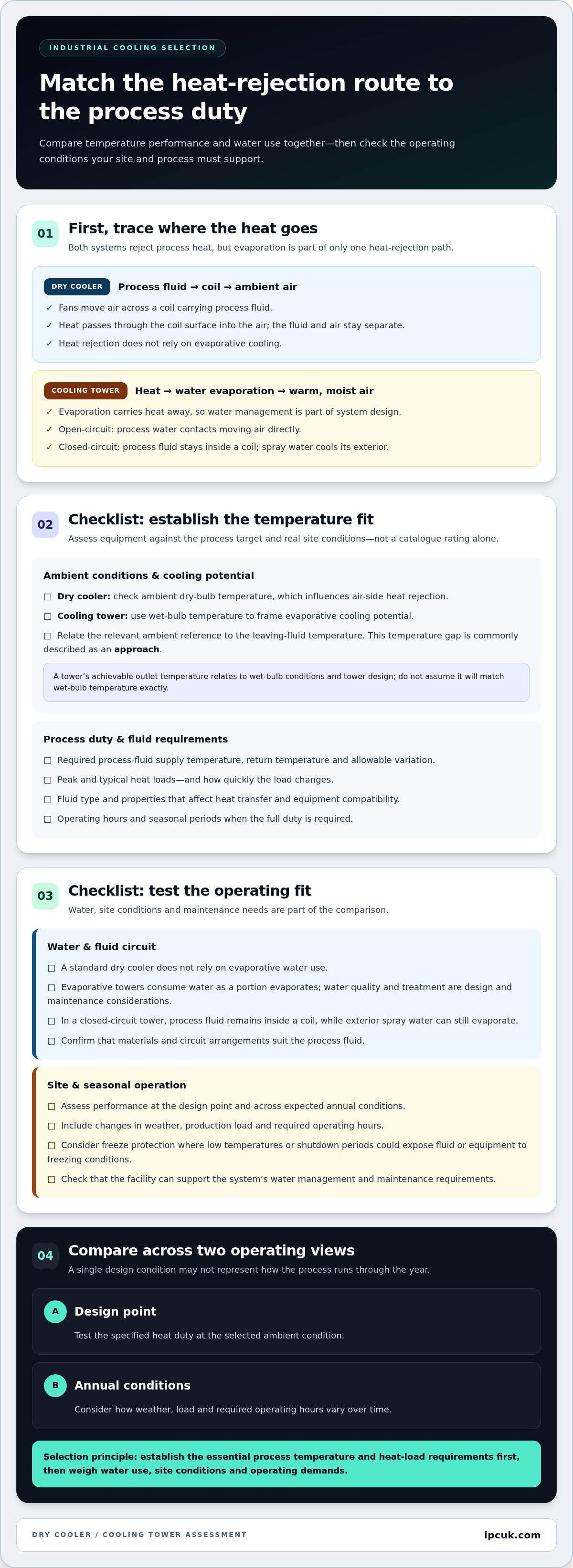
Both systems reject heat from an industrial process, but they transfer it to the environment differently. A dry cooler moves heat from process fluid to ambient air through a heat exchanger. A cooling tower uses evaporation, with water contacting the airflow either directly or through a separate circuit.
A dry cooler rejects process heat through a coil to ambient air without evaporative cooling, whereas a cooling tower rejects heat by evaporating water into an airflow.
The system boundary matters. In a standard dry cooler, process fluid circulates inside the coil and fans move air across its outside surface. Heat passes through the coil wall into the air, keeping the fluid and air separate. In a cooling tower, heat leaves with warm, moist air, but the relationship between process fluid and tower water depends on the configuration. The equipment label alone does not tell you which fluids mix or where heat transfers.
How a dry cooler rejects heat
Fans draw or push ambient air across a coil that carries process fluid. Heat moves through the coil surface into the passing air, primarily by sensible heat transfer: the air warms without water evaporation serving as the cooling mechanism. The coil keeps the process fluid separate from the external air stream.
Because air is the heat sink, achievable fluid temperatures depend on ambient conditions and equipment design, including heat-transfer surface and airflow. Assess a dry cooler against the process temperatures required and conditions at the installation site, rather than as a standalone piece of equipment.
How a cooling tower rejects heat
In an open-circuit tower, warm process water is distributed inside the tower and directly contacts moving air. A portion evaporates, carrying heat away; the cooled water is collected and returned to the process. The tower water is therefore part of the process-fluid circuit.
A closed-circuit cooling tower works differently. Process fluid remains inside a coil, while water is sprayed over the coil’s exterior and exposed to airflow. Evaporation cools this external spray water, which removes heat across the coil wall without directly mixing with the process fluid. This is still evaporative heat rejection, but the fluid arrangement differs from both an open-circuit tower and a standard dry cooler.
The Cooling Tower Principles overview describes the broader range of tower configurations. One useful performance reference is wet-bulb temperature, the lowest temperature air can approach through evaporative cooling under its current temperature and humidity. A tower’s achievable outlet temperature relates to this condition and its design; it should not be assumed to match wet-bulb temperature exactly. In the dry cooler versus cooling tower comparison, the key distinction is whether evaporation forms part of the heat-rejection path, not simply whether a coil is present.
What Governs Dry Cooler and Cooling Tower Performance?
Equipment performance only has meaning in relation to the process requirement. Start with the required process-fluid supply temperature and heat load, then assess whether each approach can meet that duty under the site’s operating conditions. A catalogue rating alone may not account for seasonal weather, variable production or time spent at partial load.
Dry-bulb temperature influences a dry cooler’s air-side heat rejection, wet-bulb temperature informs an evaporative tower’s cooling potential, and both must be assessed against the target process-fluid temperature. The gap between a relevant ambient reference and the leaving fluid temperature is commonly described as an approach. The exact reference points depend on the equipment and system arrangement.
Ambient conditions, approach temperature and process duty
For a dry cooler, ambient dry-bulb temperature is a key boundary condition. As the air entering the coil warms, the temperature difference available for heat transfer can narrow. The resulting fluid temperature depends on cooler design and the duty it must handle. Wet-bulb temperature, which reflects the combined effect of air temperature and moisture for evaporative cooling, helps frame a tower’s potential. Actual performance also depends on tower design and operating conditions.
Compare both technologies at the design point and across expected annual conditions. The design point tests the specified duty at the selected ambient condition. An annual assessment considers how weather, load and required operating hours vary over time. Include:
- Peak and typical heat loads, including how quickly they change.
- Fluid type and properties that affect heat transfer and equipment compatibility.
- Required supply temperature, return temperature and allowable variation.
- Operating hours and seasonal periods when the full duty is required.
Water, fluid quality and operating conditions
A standard dry cooler rejects heat through airflow across its coil and does not rely on evaporative water use. Evaporative cooling towers consume water as a portion evaporates, so water quality and treatment are part of system design and maintenance. Closed-circuit towers keep process fluid inside a coil, but water applied to the coil’s exterior can still evaporate.
Fluid compatibility matters too. Materials and circuit arrangements must suit the process fluid. Consider freeze protection where low temperatures or shutdown periods could expose fluid or equipment to freezing conditions. These requirements depend on the installation and operating strategy.
Controls affect how equipment responds as load and weather change. Fan operation, water distribution and equipment sequencing can influence how closely the system follows process demand. An engineering assessment should consider the expected operating profile, not only maximum capacity. Industrial Power Cooling assesses process duties when designing a bespoke industrial cooling system, coordinating equipment selection with the conditions it must serve.
Dry Cooler Versus Cooling Tower: Compare the Trade-Offs
The dry cooler versus cooling tower decision involves balancing process performance against the resources and upkeep needed to achieve it. Neither option is inherently best for every duty. Use the comparison below as a starting point; actual outcomes depend on equipment design, operating profile and site conditions.
| Factor | Dry cooler | Cooling tower |
|---|---|---|
| Heat-rejection mechanism | Air passes over a coil and removes heat from the fluid inside. | Evaporation transfers heat to an airflow; process fluid may contact water directly or remain within a separate coil. |
| Temperature potential | Performance is tied to ambient air temperature and the design’s ability to transfer heat. | Evaporative cooling can provide a different temperature relationship to ambient conditions, subject to tower design and operating conditions. |
| Water | Standard dry operation does not rely on evaporative water use. | Evaporation uses water and makes water supply and management relevant. |
| Site conditions | Ambient conditions, airflow, equipment location and available space affect suitability. | Water availability, tower location, airflow and operational management need consideration. |
| Maintenance | Coils, fans and associated components need maintenance; the system avoids routine evaporative-water treatment. | Maintenance includes equipment care and water-quality management and treatment, with requirements shaped by the design. |
This is not a universal ranking. A tower’s use of evaporation does not automatically make it the better project choice, just as reduced evaporative water dependence does not make a dry cooler suitable for every target temperature. Compare both systems against the actual duty and site constraints.
Where a dry cooler may fit
A dry cooler may suit a project where avoiding evaporative water use is important, such as a site with constrained water resources or a preference for limiting water-treatment operations. Test that preference against the process requirement. Assess ambient conditions alongside the required fluid temperature over the operating year, not only in a favourable season or at partial load.
If a dry cooler alone cannot meet the duty under relevant conditions, an auxiliary or hybrid arrangement may merit engineering assessment. The aim is to determine whether a different configuration can address demanding periods, without assuming that one arrangement will suit every season.
Where a cooling tower may fit
A cooling tower may suit a duty where evaporative heat rejection can meet the process temperature requirement under the site’s design conditions. Weigh that capability against water availability, water treatment and the resources needed for ongoing operational management. Open-circuit and closed-circuit arrangements also differ in how process fluid relates to tower water, so configuration matters to the project assessment.
Heat-rejection potential under particular conditions is not, by itself, a project-level advantage. Consider how consistently the process needs the target temperature, what water management the site can support, and how maintenance fits the facility’s operating plan. A balanced comparison starts with the required duty, then accounts for site and lifecycle constraints.
How to Select the Right Cooling Approach for an Industrial Site
Use a consistent screening sequence to compare options against the same process duty and site conditions. Separate requirements the system must meet from preferences that influence the final choice. A temperature limit or required operating condition is a design constraint; reducing dependence on evaporative water may be a preference unless site conditions make water use a hard constraint.
Build the design brief before comparing equipment
Before assessing a dry cooler versus cooling tower, assemble the information that defines the duty and installation. Document process data, seasonal conditions and operating expectations together, so neither option is assessed against more favourable assumptions.
- Define the process requirement. Record heat load, process-fluid type and properties, flow conditions, required supply and return temperatures, and acceptable temperature variation.
- Describe the operating profile. Document typical and peak loads, expected operating hours, seasonal changes and periods when full cooling capacity is essential.
- Set site conditions. Identify the design ambient conditions used for assessment, available footprint and airflow considerations, plus water availability and site constraints on water use or treatment.
- Record integration needs. Establish required redundancy, controls, connections to existing plant and maintenance access. Treat these as project-specific requirements, not assumptions about a standard configuration.
- Separate requirements from preferences. Mark each item as essential or preferred. This keeps a non-negotiable process temperature distinct from an objective such as reduced water dependence.
Screen options and test seasonal operation
Assess both approaches at the same design point, then test them against the expected seasonal range and load profile. A concept that meets peak duty also needs to be considered in typical operating conditions, where control strategy and equipment staging may affect how the system responds.
| Assessment item | Dry cooler | Cooling tower |
|---|---|---|
| Required fluid temperatures and heat load | Record whether the duty is met at design and seasonal conditions. | Record whether the duty is met at the same conditions. |
| Water and site constraints | Assess site fit and the value of avoiding evaporative water use. | Assess water supply, treatment and operational management. |
| Access and integration | Record maintenance access, controls and plant connections. | Record maintenance access, controls and plant connections. |
Use the table to identify which option meets every hard requirement, then weigh preferences and operating implications. Include the people, access and procedures needed to maintain the selected system, not only the equipment footprint. If neither approach alone meets the full duty across relevant conditions, include a hybrid arrangement in the engineering assessment rather than forcing a single-technology choice.
Industrial Power Cooling assesses process duties and develops bespoke systems through design, manufacture and installation. Discuss your industrial cooling requirements as part of a project-specific assessment.
How Bespoke Engineering Turns the Comparison into a Working System
A comparison becomes useful when its findings shape a system concept that fits the process and site. The selection brief informs more than the choice between a dry cooler and a cooling tower. It also guides equipment configuration, connections to existing plant, controls and the site pipework needed to integrate the system.
From process requirements to engineered configuration
Industrial Power Cooling designs systems for data centres, power generation, process plants and hospitals. Each application has its own duty, operating profile and site constraints, so project requirements guide equipment selection and configuration rather than relying on a standard arrangement. Dry coolers and cooling towers are among the equipment categories that may form part of the assessment.
Once the duty and constraints are understood, the system concept can account for connections to the process, control requirements and pipework integration. The aim is a coherent design in which individual components are considered as part of the wider installation. If the comparison points to a combined or alternative arrangement, assess its suitability against the same documented process requirements.
- System concept: Translate the process duty and site constraints into a cooling-system approach.
- Equipment configuration: Match cooling equipment to the required duty and intended system arrangement.
- Controls and integration: Coordinate control requirements with the equipment and existing plant interfaces.
- Site pipework: Plan connections as part of the installation, rather than treating them as separate from system design.
Project delivery and ongoing support
Industrial Power Cooling manages projects from conceptual design through manufacture and installation. Its scope includes industrial cooling system pipework installation where it supports the project. Equipment configuration, controls and site integration can therefore be considered in relation to the same process requirements from concept onward.
Selection also has a lifecycle dimension. Cooling towers and units need maintenance and repair support as part of ongoing asset care, and those needs belong in the project discussion alongside installation and operating conditions. Planning for access and maintenance helps bring lifecycle requirements into the system arrangement, while recognising that needs vary by site.
For a project-specific assessment, share your process duty and site constraints with Industrial Power Cooling’s engineering team. This provides a practical basis for developing the system concept, equipment configuration and installation scope.
Take the Next Step with a Project Brief
Before finalising equipment selection, turn the decision into a clear project brief. Record the process duty, conditions the system must meet, site constraints and priorities for ongoing operation. This gives the engineering work a defined basis and helps align equipment configuration, controls and installation interfaces with the plant’s requirements.
The dry cooler versus cooling tower choice is most useful when it leads to a system concept that can be developed, manufactured and integrated for the specific application. Industrial Power Cooling designs, manufactures and installs bespoke industrial cooling systems, connecting project requirements with delivery.
Share your process and site requirements to start a practical discussion about the next stage of your project. Discuss your industrial cooling requirements with IPC and take the first step towards an engineered approach suited to your facility.
Frequently Asked Questions
Is a dry cooler the same as a closed-circuit cooling tower?
No. A dry cooler transfers heat from process fluid in a coil to air without using evaporating water in its standard configuration. A closed-circuit cooling tower also keeps process fluid inside a coil, but water is applied to the coil’s exterior and evaporates into the airflow. To distinguish equipment with similar labels, trace the process-fluid and spray-water circuits on the system schematic.
Can a dry cooler and cooling tower operate in the same industrial system?
Yes. A system can use both, for example, assigning different equipment to different loads or operating modes. The arrangement may shift duty as conditions change, but it needs coordinated controls and compatible flow paths. The design must account for how equipment responds to changing load, which units operate, and how the system maintains process requirements.
What happens if a dry cooler cannot reach the required process temperature?
If the dry cooler cannot meet the target under relevant ambient conditions, it may not be suitable as the sole heat-rejection method for that duty. Reassess the operating conditions and consider whether a different configuration, an evaporative stage, a hybrid system or a chiller could provide the required temperature. The appropriate response depends on when the shortfall occurs and how critical the target is to the process.
Does a cooling tower need water treatment?
Usually, yes. Tower water can be affected by scaling, corrosion and biological growth, so water-quality management and treatment form part of cooling-tower operation. The approach depends on the tower configuration and water conditions. In a closed-circuit tower, process fluid is separated from the external spray water, but the spray-water circuit still needs management. A dry cooler avoids evaporative tower-water treatment, though its process-fluid circuit still needs appropriate care.
How does cold weather affect a dry cooler?
Cold ambient air can increase the temperature difference available for heat rejection, but low temperatures also raise the risk of fluid freezing in exposed equipment or pipework. The design and operating plan should account for the process fluid, shutdown periods and local conditions. Controls and a suitable freeze-protection strategy can help manage cold-weather operation; the details need to match the installation rather than follow a generic rule.
Is evaporative cooling always more energy-efficient than dry cooling?
No. The dry cooler versus cooling tower energy comparison depends on weather, process load, equipment design and how performance is measured. Evaporative cooling may meet a temperature target under conditions where a dry cooler needs more airflow or additional cooling, but tower pumps, fans and water-management equipment also use energy. Compare annual operation at the required duty, including auxiliary equipment, rather than relying on a general efficiency label.
Planning a dry cooler, cooling tower or combined industrial cooling system? Discuss your process duty and site requirements with Industrial Power Cooling to develop a project-specific system approach.
