

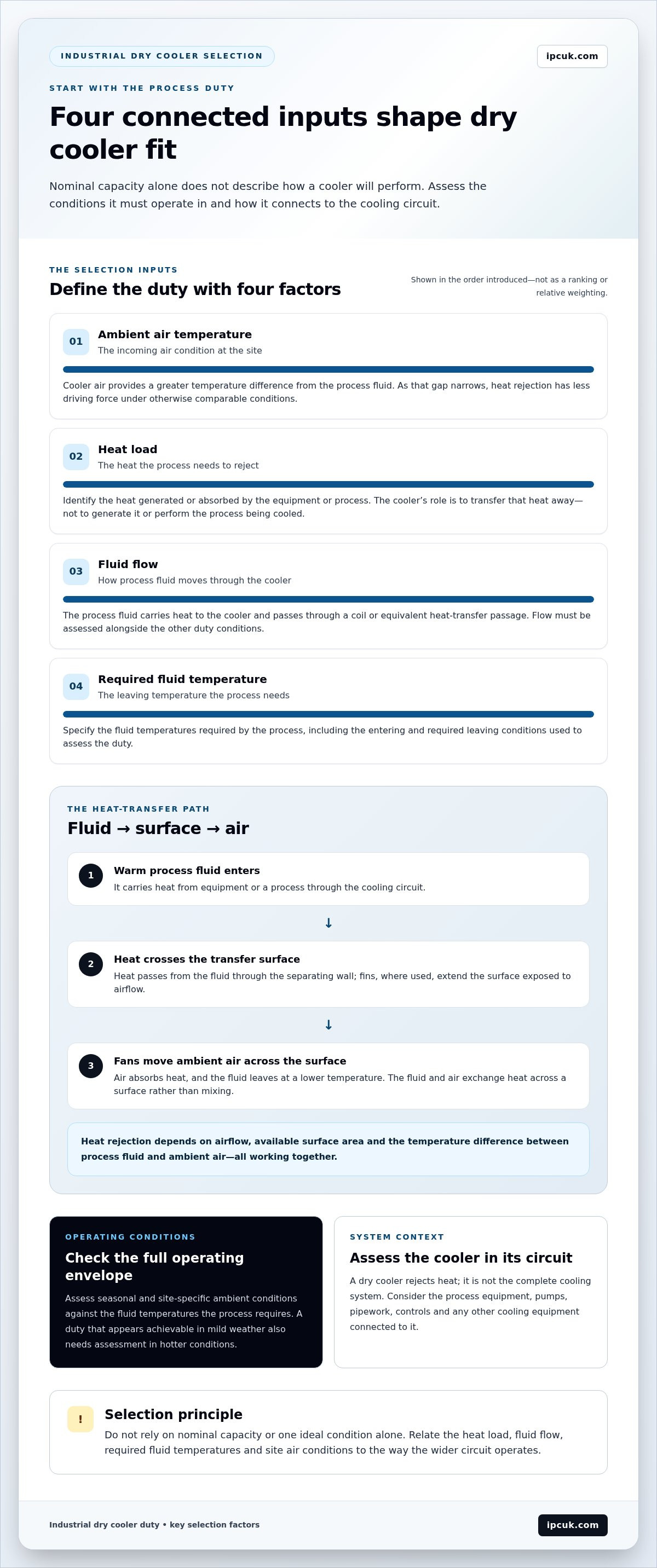
Choosing industrial dry coolers starts with the process duty, not a catalogue description. Ambient air temperature, heat load, fluid flow and the required fluid temperature all affect how effectively a cooler can reject heat.
Comparing nominal capacities alone can lead to a poor fit. The selection needs to reflect the conditions the unit will operate in and how it connects to the wider cooling system. This article explains how industrial dry coolers transfer heat, which design variables shape performance and what information helps assess suitability for a specific cooling duty.
You’ll also learn where dry coolers fit in applications such as data centres, power generation, process plants and hospitals, and how they can work alongside other cooling equipment. Finally, we’ll look at how engineering, manufacture and installation can be coordinated as one project. Industrial Power Cooling designs, manufactures and installs bespoke industrial cooling systems, bringing these stages together around the requirements of the application.
Key Takeaways
- See how a dry cooler fits into a cooling circuit without confusing the unit with the complete system.
- Understand how heat moves from process fluid to ambient air, and how this differs from evaporation-based cooling.
- Use process duty, fluid conditions, site constraints and ambient conditions to define project requirements for industrial dry coolers.
- Build a useful project brief by gathering key duty and operating information before design begins.
- Learn how IPC can coordinate bespoke cooling projects from conceptual design through manufacture and installation.
Industrial dry coolers in industrial cooling systems
An industrial dry cooler transfers heat from process fluid to ambient air. It sits within a cooling circuit, receiving fluid that has absorbed heat from equipment or a process and returning it at a lower temperature. The cooler rejects heat; it doesn’t generate it or perform the process that needs cooling.
Industrial dry cooling is “dry” because heat transfers to the air without relying on water evaporation at the cooler. Fans move ambient air over a heat-transfer surface while the process fluid remains within the circuit. This distinguishes dry cooling from evaporative methods, including cooling towers that use evaporation as part of heat rejection. For a broader overview of cooling tower principles and applications, see dry cooling towers.
The distinction matters when planning a complete system. A dry cooler is one component in a circuit that may also include process equipment, pumps, pipework, controls or other cooling equipment. Its suitability depends on the required duty and actual operating conditions, not just the equipment label or a nominal capacity. The same type of unit may serve different roles depending on the circuit arrangement and the temperatures the process requires.
What does a dry cooler cool?
A dry cooler cools a circulating process liquid. The liquid passes through a coil or another heat-transfer surface, where heat moves from the fluid to the air flowing across the surface. Water and water-glycol mixtures are common examples of process fluids, but they aren’t universal specifications. Fluid choice, operating temperatures and other requirements depend on the application and the wider circuit.
The fluid carries heat away from process equipment, such as machinery or a production system, and delivers it to the cooler for rejection. The process and the cooler therefore have different functions: one produces or absorbs heat, while the other transfers it away. Keeping that distinction clear helps define the duty the cooling equipment must meet.
Where industrial dry coolers are used
Industrial dry coolers can be used for industrial process cooling, refrigeration duties and free-cooling arrangements. In a free-cooling application, ambient air can cool the process fluid when conditions allow, potentially reducing reliance on mechanical cooling. Whether that arrangement can meet the duty depends on the required fluid temperatures and conditions at the site.
Industrial Power Cooling works with applications in data centres, power generation, process plants and hospitals. These sectors have different processes and operating demands, so assess a cooler in the context of its specific circuit rather than inferring its role from the sector alone. Start by identifying what generates heat, which fluid carries it and the conditions under which the cooler must reject it. Those requirements provide the basis for assessing project fit.
How industrial dry coolers transfer heat from process fluid to air
Heat rejection follows a continuous path: warm process fluid moves through a heat-transfer surface, heat passes through that surface, and fans draw or push ambient air across it. As the air absorbs heat, the fluid leaving the cooler is at a lower temperature. The process depends on both sides of the heat exchanger working together, not on the fan or coil in isolation.
This is sensible heat rejection: the air’s temperature rises as it takes up heat, without water evaporating as the means of cooling. That differs from evaporative heat rejection, where some water changes into vapour and carries heat away. In a dry cooler, the process fluid and air exchange heat across a surface rather than mixing.
The heat-transfer path through a dry cooler
Inside the unit, process fluid flows through a coil or equivalent heat-transfer passage. Heat moves from the fluid through the separating wall to the outer surface, then into the air passing over it. Fins, where used, extend the surface exposed to airflow and help transfer heat between the unit and the moving air. The basic path remains the same: fluid, surface, air.
Fans establish the airflow needed to carry heat away from the surface. Their number, position and arrangement vary with the equipment design, as do the configuration and layout of the heat-transfer sections. Heat rejection depends on the balance between airflow, available surface area and the temperature difference between process fluid and ambient air. Increasing one factor alone doesn’t establish the unit’s actual duty. The combined design and operating conditions matter.
Why ambient temperature affects operating performance
The temperature of the incoming air influences the temperature difference driving heat transfer. If ambient air is cooler than the process fluid, heat can pass to it. As the temperature gap narrows, the cooler has less driving force for rejecting heat under otherwise comparable conditions. A duty that appears achievable in mild weather therefore needs assessment against hotter operating conditions too.
Seasonal temperatures and site-specific ambient conditions are design inputs, not a guarantee of a particular output. Engineers need to relate them to the process-fluid temperatures required at relevant operating points. Assess the project’s operating envelope, including the conditions under which the process must continue to receive cooling, rather than relying on a single ideal condition.
In practice, the specified duty is assessed alongside fluid flow, entering and required leaving temperatures, and the air conditions at the site. These factors inform the heat-transfer surface and airflow needed, while the wider circuit determines how the cooler operates as part of the system. A unit’s stated capacity is meaningful only in relation to its rating conditions and the project duty it must meet.
For project-specific engineering, IPC’s industrial cooling system design connects dry cooler selection with the requirements of the wider circuit.
Industrial dry cooler design: the variables that shape project fit
Industrial dry coolers are selected for a defined process duty and site, not by equipment shape or a general capacity label. The assessment brings together four groups of inputs: process duty, fluid conditions, ambient conditions and site constraints. Some are fixed requirements, such as the process temperature that must be maintained. Other choices, including equipment configuration and airflow arrangement, can be engineered to meet those requirements within the available site conditions.
This distinction is useful early in a project. A design team can optimise the equipment, but it can’t resolve an unclear heat load or undefined operating requirement by choosing a different casing. The project brief should identify firm process needs and flag data that is estimated, changing or still to be established.
| Design input | Engineering relevance |
|---|---|
| Heat rejection duty | Defines the heat the cooler must remove under stated operating cases. |
| Fluid and flow conditions | Informs the heat-transfer arrangement and how the circuit supplies the cooler. |
| Target inlet and outlet temperatures | Sets the required process-fluid temperature range at the cooler. |
| Ambient conditions | Establishes the air conditions against which heat rejection is assessed. |
| Site and access constraints | Shapes equipment location, airflow assessment and practical layout. |
Process and operating data to establish
Start with the required heat rejection, fluid type, flow conditions and target temperatures at the cooler inlet and outlet. State the normal operating case separately from relevant peak-load and turndown cases, when the process runs below its usual duty. This prevents a single operating point from standing in for the full demand. If process data is missing or expected to change, identify it as an engineering item to resolve instead of treating an assumption as a fixed requirement.
Temperature requirements should relate to the actual process, not just the preferred outlet value for the cooling equipment. Assess the cooler’s design duty against the fluid and flow conditions in which it will operate, including variations that affect the circuit.
Site layout, airflow and equipment configuration
Record the available footprint, proposed installation position, maintenance access and routes for air to reach and leave the equipment. Nearby walls, structures or other plant can obstruct airflow or contribute to recirculation, where discharged warm air returns towards the cooler’s air intake. Include these conditions in the airflow assessment. Equipment that fits physically may still be poorly positioned for effective air movement.
Flat and V-shaped arrangements are alternative configuration approaches, not a universal ranking. Their suitability depends on the duty, available space, airflow pathways and site access. Engineers assess the whole arrangement against those constraints, then select a configuration that meets the project requirements. Shape alone doesn’t establish whether a unit is appropriate. The design must reconcile process needs with ambient conditions and the realities of the installation site.
Assessing an industrial dry cooler duty before design begins
A useful project brief turns process needs and site realities into engineering inputs. Describe not only the heat to be rejected, but also how the dry cooler connects to pumps, pipework and the wider cooling circuit. The steps below help organise that information before equipment design begins.
- Define the thermal duty. State the required heat rejection and identify the process or equipment producing the heat. Separate confirmed requirements from estimates.
- Describe the fluid and flow. Record the fluid characteristics and flow conditions through the cooler. These details help engineers assess the heat-transfer duty in the context of the circuit.
- Specify required temperatures. Give the expected inlet and target outlet temperatures at the cooler, and clarify which process requirements those values support.
- Document operating patterns. Distinguish normal operation from peak demand, turndown and other known variations. Note when the process operates under those cases and whether demand changes over time.
- Map site and system interfaces. Record ambient conditions, available location, airflow constraints, access needs, connection points and the relationship to pumps and pipework.
Build a clear thermal duty statement
Bring the heat load, fluid, flow and temperature requirements together in a concise duty statement. Include the operating cases that matter, rather than relying on a single assumed condition to represent the process. Where information is provisional or unavailable, label it clearly and identify what must resolve it. Industrial dry cooler selection should follow verified process and site data. This keeps design decisions traceable to the requirements they are intended to meet.
Clarity at this stage also helps distinguish fixed process needs from choices that can be optimised. Required process temperatures may be fixed, while equipment configuration can be developed around the duty and site. Explicit assumptions make that distinction easier to review as project information develops.
Map site conditions and system interfaces
Describe the intended location, footprint limits, airflow pathways and relevant access requirements. Note nearby structures or equipment that could obstruct airflow or create a recirculation risk. These details let engineers assess whether the proposed arrangement is compatible with the site.
Then show how the cooler interfaces with the wider circuit. Identify connection points and the relationship to pumps, pipework and other cooling equipment, along with the boundaries of the project scope. Clear interface information supports coordinated design development and helps avoid treating the cooler as an isolated component. IPC’s cooling project services bring the duty brief and system interfaces into the engineering discussion.
From dry cooler concept to an integrated IPC cooling project
A dry cooler’s performance depends on more than the unit itself. Its duty, position in the circuit and connection to other equipment need to be considered as part of the cooling system. Once process and site requirements are defined, the project can move from engineering concept to coordinated design, manufacture and installation, with interfaces considered across the scope.
Industrial Power Cooling (IPC) designs, manufactures and installs bespoke industrial cooling systems, managing projects from conceptual design through to installation. Established for over 20 years, IPC supplies dry coolers and coordinates equipment with the requirements of the wider application. Its projects support cooling needs in data centres, power generation, process plants and hospitals.
Coordinating design, manufacture and installation
Early project information provides the basis for conceptual design. The process duty, operating conditions, available site space and system connections inform how the dry cooler is assessed alongside the rest of the cooling circuit. Where the project requires additional equipment, the design can consider related products such as chillers, cooling skids and electrical control panels, as well as the pipework needed to connect system components.
As the design develops, manufacture and installation remain connected stages rather than separate decisions. Equipment configuration and interfaces can be considered in relation to the defined duty and site, supporting a coordinated project scope. Bespoke engineering is useful when requirements call for a solution shaped around specific process conditions or site constraints, rather than assuming a standard arrangement will fit.
Planning for operational support
Operational considerations belong in project planning too. Access for inspection and maintenance can influence equipment location and surrounding layout, so include these needs as the design takes shape. This keeps practical access in view alongside cooling duty and system connections.
IPC provides maintenance and repair support for cooling units and cooling towers to clients across the globe. Considering this support as part of the equipment lifecycle connects the initial project scope with ongoing operational needs, while recognising that maintenance requirements vary by installation and duty.
For industrial cooling requirements involving a dry cooler or a wider bespoke system, IPC can design, manufacture and install your cooling project. Share the process duty, site context and system interfaces to give the project a practical starting point.
Move from cooling duty to a workable project plan
Turn operating requirements into a defined project scope by bringing together the process duty, site conditions and system interfaces. Use these inputs to guide decisions about the cooling arrangement and its role in the wider circuit. This gives engineering discussions a practical foundation and keeps equipment choices aligned with the application’s needs.
Industrial Power Cooling can carry the work from concept into manufacture and installation, with bespoke project capability shaped around the application. Its experience spans more than 20 years, and global maintenance and repair support can form part of the equipment lifecycle. If you’re planning a new system or reviewing an existing cooling duty, discuss your industrial cooling requirements with IPC.
Frequently Asked Questions
Do industrial dry coolers use water?
Industrial dry coolers reject heat to ambient air without using evaporation as their heat-rejection method, so the cooler itself doesn’t need water for that process. This doesn’t mean the wider facility or connected cooling system uses no water. For example, a site may have water-consuming production processes or separate evaporative equipment. Assess water use across the complete application rather than inferring a site-wide reduction from the cooler alone.
Can an industrial dry cooler operate in cold weather?
It can, but cold-weather suitability depends on the process fluid, required temperatures, system design and operating strategy. Lower ambient temperatures change heat transfer and may require careful control to keep the process within its operating limits. For example, a process needing a stable outlet temperature through seasonal changes may have different control needs from one with variable demand. Assess the full operating envelope; there isn’t one minimum ambient temperature that applies to every project.
Can a dry cooler provide free cooling?
Yes. A dry cooler can support free cooling when ambient air conditions allow it to meet the process duty without mechanical refrigeration for that duty. For instance, a facility may be able to use the cooler during cooler periods, while another part of the system continues to serve loads needing refrigeration. The available operating mode depends on required process temperatures, system arrangement and ambient conditions. It shouldn’t be assumed to operate year-round or guarantee energy savings.
What fluids can circulate through an industrial dry cooler?
Industrial dry coolers reject heat from process liquids, with water and water-glycol mixtures among the examples used where suitable. Compatibility depends on the liquid’s properties and the cooler’s design, so assess the fluid as part of the project rather than selecting it from a generic list. Provide the fluid details and operating requirements when preparing a duty brief. This allows the equipment assessment to reflect the actual circuit instead of assuming every liquid is suitable.
How does a dry cooler differ from a condenser?
A dry cooler generally transfers heat from a circulating liquid to ambient air. A condenser, by contrast, changes vapour or refrigerant into liquid as part of a refrigeration or process cycle. In some systems, a dry cooler may cool a liquid circuit associated with refrigeration equipment, while the condenser performs a separate phase-change function. Terminology and configuration vary by application, so identify the fluid and the equipment’s role in the circuit before comparing components.
How much does an industrial dry cooler project cost?
There isn’t one standard project price. Cost depends on the thermal duty, operating conditions, selected configuration, site constraints and work included in the project scope. A supply-only requirement differs from a project involving wider system coordination or installation. IPC develops bespoke industrial cooling projects, so a useful discussion starts with defined process requirements, site information and system interfaces. These details help frame a project-specific assessment.
How long does it take to design and install an industrial dry cooler?
Project duration depends on the engineering requirements, equipment scope, site conditions, system interfaces and installation planning. A cooler integrated into a wider system may involve coordination beyond the equipment itself, so a standard timeline wouldn’t represent every project. IPC can manage work from conceptual design through manufacture and installation, with timing shaped by the project requirements. A clear duty brief and site information help establish the scope for planning the work.
